
What are janitorial services?
Why the Words Behind Janitorial Services Matter
In practical terms, Janitorial Services are recurring interior cleaning and light maintenance performed on an agreed schedule, often outside regular office hours. Office cleaning usually describes the same day-to-day environment in simpler, more familiar language, while Commercial Cleaning often refers to broader or periodic work such as carpet extraction, floor refinishing, window cleaning, and post-construction cleaning.
The right service plan connects the routine work with the periodic work, then proves that both were completed.
A proposal should define the work before anyone compares prices. If “full janitorial service” appears above a short list containing garbage collection and vacuuming, the buyer should ask whether washrooms, touchpoints, restocking, kitchens, and inspection records are included. A shared vocabulary prevents a low price from looking attractive because important tasks were left unstated.
Janitorial services generally mean scheduled cleaning of occupied interior areas. The scope may include washrooms, floors, garbage and recycling, breakrooms, reception areas, meeting rooms, and common touchpoints. Light maintenance can include reporting a damaged dispenser, noticing a leak, or flagging a supply shortage, but repairs and restoration normally require separate arrangements.
The word “janitor” is also used less often in some workplaces, where office cleaning or commercial cleaning sounds more specific and less tied to an individual job title. That change in language doesn’t remove the work. It often reflects a broader service model that includes cleaning crews, supervisors, inspections, supply coordination, and specialty services.
Contract control
Use Terminology as a Contract Control
A facility manager can standardize terms by identifying four important details in the scope of work:
Area
Identify every room, washroom, corridor, stairwell, kitchen, and storage area.
Task
State whether the service includes cleaning, sweeping, mopping, dusting, disinfecting, restocking, inspection, or reporting.
Frequency
Separate each shift, weekly, monthly, seasonal, and project-based work.
Evidence
Specify checklists, inspection results, issue reports, and completion records.
Practical rule
If a task matters to occupants, safety, compliance, or the appearance of the facility, it belongs in the written scope rather than in an informal conversation.
How they compare
Janitorial Services Compared with Office and Commercial Cleaning
The distinction is easiest to understand through frequency, scope, and trigger. Janitorial work is a routine operating service. Office cleaning is a common customer-facing term for maintaining workplace interiors. Commercial cleaning is broader and often describes specialized or project-based work that cannot be completed effectively through a nightly routine.
| Category | Frequency | Tasks | Goals |
|---|---|---|---|
| Janitorial services | Recurring, often each shift or on a weekly schedule | Sweeping, Mopping, Dusting, Garbage Removal, Restocking Supplies & Disinfecting various areas of the building. | Keeping spaces free of dust, dirt, grime, garbage, cobwebs, and ensuring washrooms are clean and sanitized. Disinfecting frequently touched points has also been added to the list after the COVID pandemic. |
| Office cleaning | Recurring, with daytime or after-hours options | Customized Janitorial Services for various types of office spaces | Ensuring the Janitorial Services provided meet applicable standards for that specific industry. |
| Commercial cleaning | Periodic or project-based | Carpet extraction, floor refinishing, windows, high dusting, post-construction cleaning | Addressing any cleaning related issues that happen over time and could not be covered by regular janitorial services. |
A small office may use “office cleaning” to describe evening rubbish removal, washroom cleaning, kitchen wiping, and vacuuming. A warehouse, school, dental clinic, or manufacturing office may require different procedures, timing, personal protective equipment, and reporting. The phrase commercial cleaning can cover those environments, but it doesn’t automatically define the standard.
A practical plan normally has two layers
Routine janitorial service keeps the facility functional and presentable between operating days.
Periodic commercial cleaning provides means to restore facilities to its best operating appearance and when routine cleaning can no longer remove embedded soil, wear, or project residue.
What's Included
What Daily and Weekly Janitorial Service Covers
A strong janitorial scope follows the movement of people through the building. Staff enter through reception, use shared touchpoints, work at desks, visit kitchens and washrooms, and leave waste behind. The cleaning schedule should reflect those patterns instead of assigning the same treatment to every room.
Washrooms set the service baseline
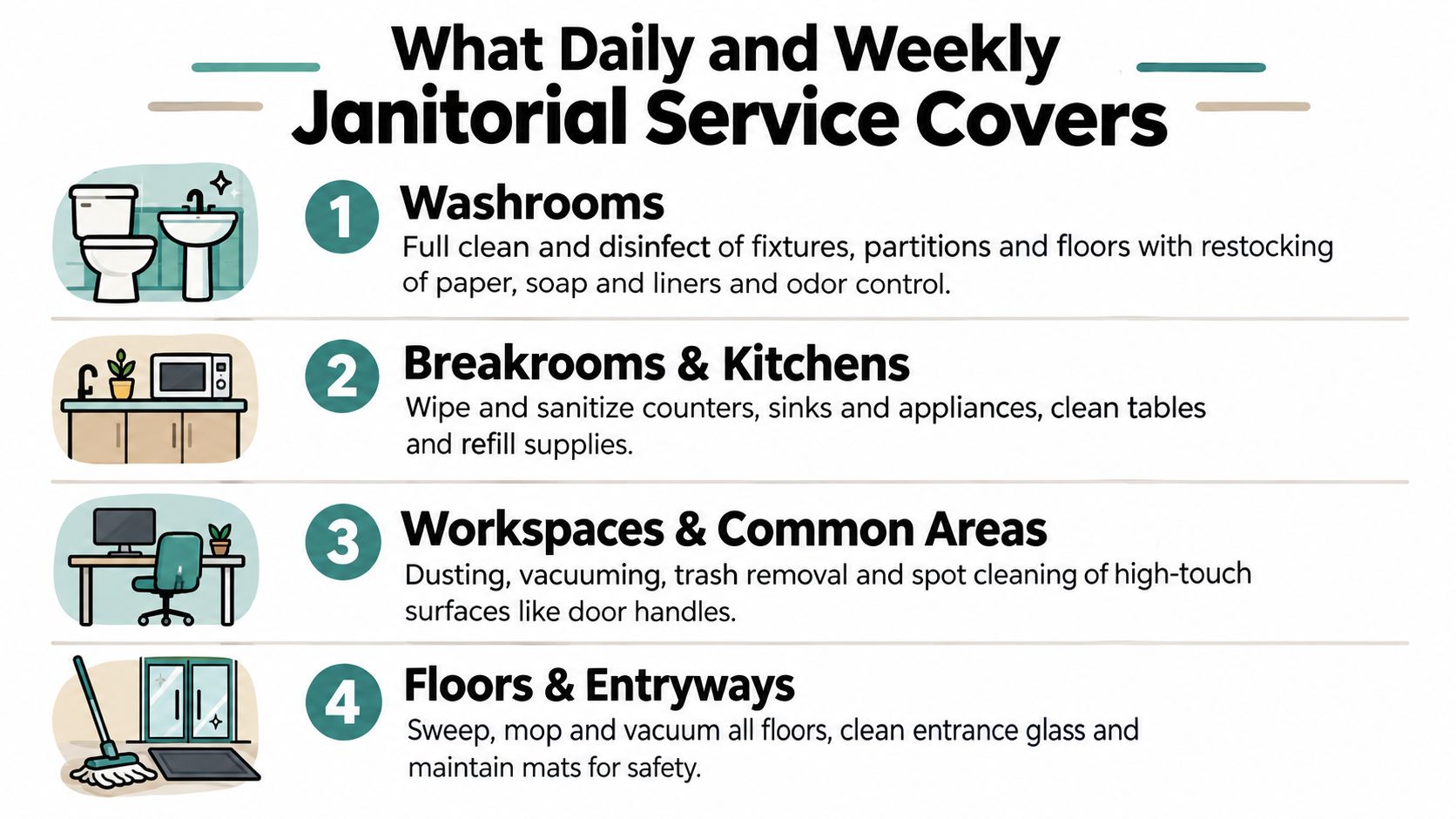
Washroom work usually includes cleaning and disinfecting fixtures, partitions, sinks, mirrors, floors, and frequently touched hardware. Crews may also restock paper products, soap, and bin liners, then report damaged dispensers, leaks, odours, or plumbing concerns.
Records matter here. Since July 1, 2025, employers providing washrooms must keep them clean and maintain cleaning, restocking, and inspection records. From January 1, 2026, those washrooms must be cleaned at least once per shift, with visible logs near each washroom, according to the Ontario compliance summary from MERO ↗. A service that looks complete but leaves no usable record may not satisfy the operational need.
Touchpoints require correct chemistry
Door handles, light switches, lift buttons, railings, taps, shared kitchen surfaces, and other high-touch areas need a defined method. Cleaning comes before disinfecting, and the disinfectant must remain wet for the product’s full contact time. Public Health Ontario gives the practical example that a three-minute requirement means the surface stays wet for three minutes, with reapplication if it dries early, as explained in its environmental cleaning guidance ↗.
Floors usually receive vacuuming, mat care, dust-mopping, damp-mopping, and spot treatment for spills. Reception, meeting rooms, kitchens, and breakrooms need rubbish removal, surface wiping, table cleaning, and a presentable reset between shifts.
Match frequency to occupancy
Routine tasks aren’t valuable because they’re exotic. Their value comes from consistent completion, sensible prioritization, and adjustments when occupancy, events, weather, or a spill changes the workload.
Knowing the following is key:
- Room-level scope: Which rooms receive service, and which are excluded?
- Task frequency: Which items occur each shift, weekly, or only during an inspection?
- Supply responsibility: Who provides paper, soap, liners, and dispensers?
- Quality evidence: How are missed tasks, complaints, and corrective actions recorded?
Periodic cleaning
Periodic Commercial Cleaning That Complements Janitorial Service
An office can pass a nightly check and still carry wear that routine work cannot correct. A floor may be vacuumed and mopped properly while its finish needs restoration. Carpet can look acceptable from the doorway while soil remains embedded below the surface.
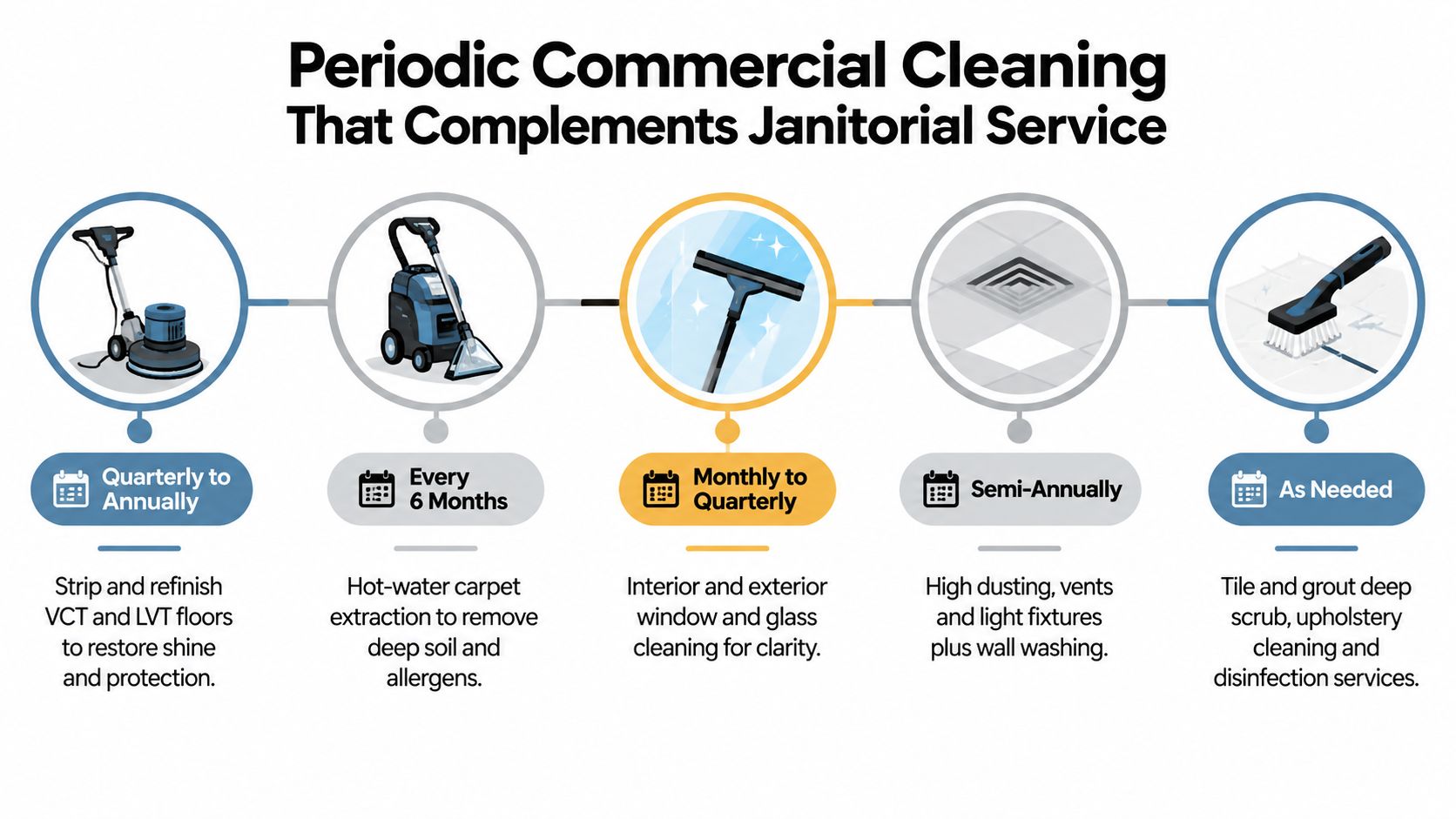
Periodic commercial cleaning works as a calendar layer over janitorial service. It may include:
Floor restoration
Strip and refinish VCT or LVT flooring on a planned quarterly-to-annual cycle, based on the surface and operating conditions.
Carpet extraction
Use hot-water extraction when vacuuming no longer removes embedded soil. Foot traffic, entrance conditions, and spills help determine timing.
Glass care
Clean interior and exterior windows, partitions, and entrance glass through a defined rotation.
High dusting
Remove dust from vents, ledges, light fixtures, ceiling details, and other raised surfaces.
Project cleaning
Complete post-construction, move-in, or move-out cleaning when a project milestone creates a defined need.
Each task has its own equipment and controls. An auto-scrubber, rotary floor machine, HEPA vacuum, water-fed pole, extractor, or specialized agitation tool may suit different surfaces. Since this work needs different labour, equipment, and preparation, it is commonly priced separately rather than included in the nightly rate.
Use scheduled walk-throughs and contract renewals to review the calendar. Check floor appearance, carpet condition, glass visibility, dust accumulation, and upcoming occupancy changes before approving work. Ontario’s 2025-2026 washroom compliance rules also show why records matter: a surface can appear clean, yet buyers still need documented evidence that required routines were completed.
The operating model is complementary
Janitorial service keeps the facility ready for daily use, while periodic commercial cleaning services restore surfaces that routine work cannot fully reset. Together, they connect visible condition with planned maintenance and accountable scheduling.
Janitorial Services Pricing
Pricing, Contracts, and What Drives the Cost
A low monthly quote can look attractive until the first missed washroom check, supply charge, or extra visit appears. Compare cleaning prices through a defined scope, then match the billing model to how the facility operates.
| Model | Cost Drivers | Best Fit |
|---|---|---|
| Fixed monthly | Agreed scope, frequency, staffing, supplies, and planned supervision | Facilities needing predictable budgeting |
| Per-square-foot | Cleanable area, building use, task density, and frequency | Comparable office layouts with measurable space |
| Hourly or per-visit | Crew time, travel, access, task complexity, and requested additions | Variable schedules or occasional service |
The price follows the work. Usable floor area, cleaning frequency, building classification, washroom and kitchen density, floor types, occupancy, access restrictions, waste volume, and regional labour conditions all affect the quote. Ontario’s labour market includes approximately 39,600 janitors, caretakers, and heavy-duty cleaners, with 76% working full time and 24% part time, according to Ontario labour-market data ↗.
Treat exact price ranges carefully unless the scope and market date are clear. Periodic floor, carpet, window, and post-construction work is commonly quoted per job because equipment, access, soil, and surface condition vary. A low bid may assume fewer visits, less supervision, omitted supplies, limited insurance, or staffing that cannot support the promised schedule.
A quote should make the handoffs visible
Routine labour: Crew hours, frequency, and supervisor coverage.
Consumables: Soap, paper, liners, and other facility supplies.
Periodic work: Floor care, carpet extraction, windows, and high dusting.
Compliance: Training, inspections, documentation, and safety controls.
Commercial terms: Notice periods, cancellation, extras, and service recovery.
Bundled pricing simplifies budgeting and accountability. It can also charge for periodic work the facility does not need during every contract period. Unbundled pricing gives the buyer more control over specialty tasks, while requiring closer management of scheduling, approvals, and separate line items.
Before signing, test the contract against ordinary changes: an occupancy increase, a missed visit, a new washroom requirement, or a request for additional floor care. The guide to cleaning vendor management ↗ can help organize scope, service levels, change controls, and contract administration.
Compliance & Safety
Compliance, Safety, and Documentation
A janitorial handover should function like an operating file, not a polished task list. It needs to show how workers handle chemicals, protect occupants, record completed work, and respond when conditions change. For example, staff using workplace chemicals need WHMIS training, access to Safety Data Sheets, correct dilution procedures, suitable personal protective equipment, and rules for storing products separately. Bleach must never be mixed with ammonia or other cleaners because the combination can create hazardous gas, as explained in the cleaner and janitor safety guidance ↗.
Disinfection has its own control points. A surface can look wet without receiving the required treatment. The crew must follow the product label, SDS, organizational procedure, and specified dwell time.
Canadian guidance identifies a Drug Identification Number for disinfectants, and describes an authorized bleach fallback of 5 mL of 5% sodium hypochlorite in 250 mL of water, with a one-minute contact time, where that procedure is appropriate, as set out by CCOHS ↗.
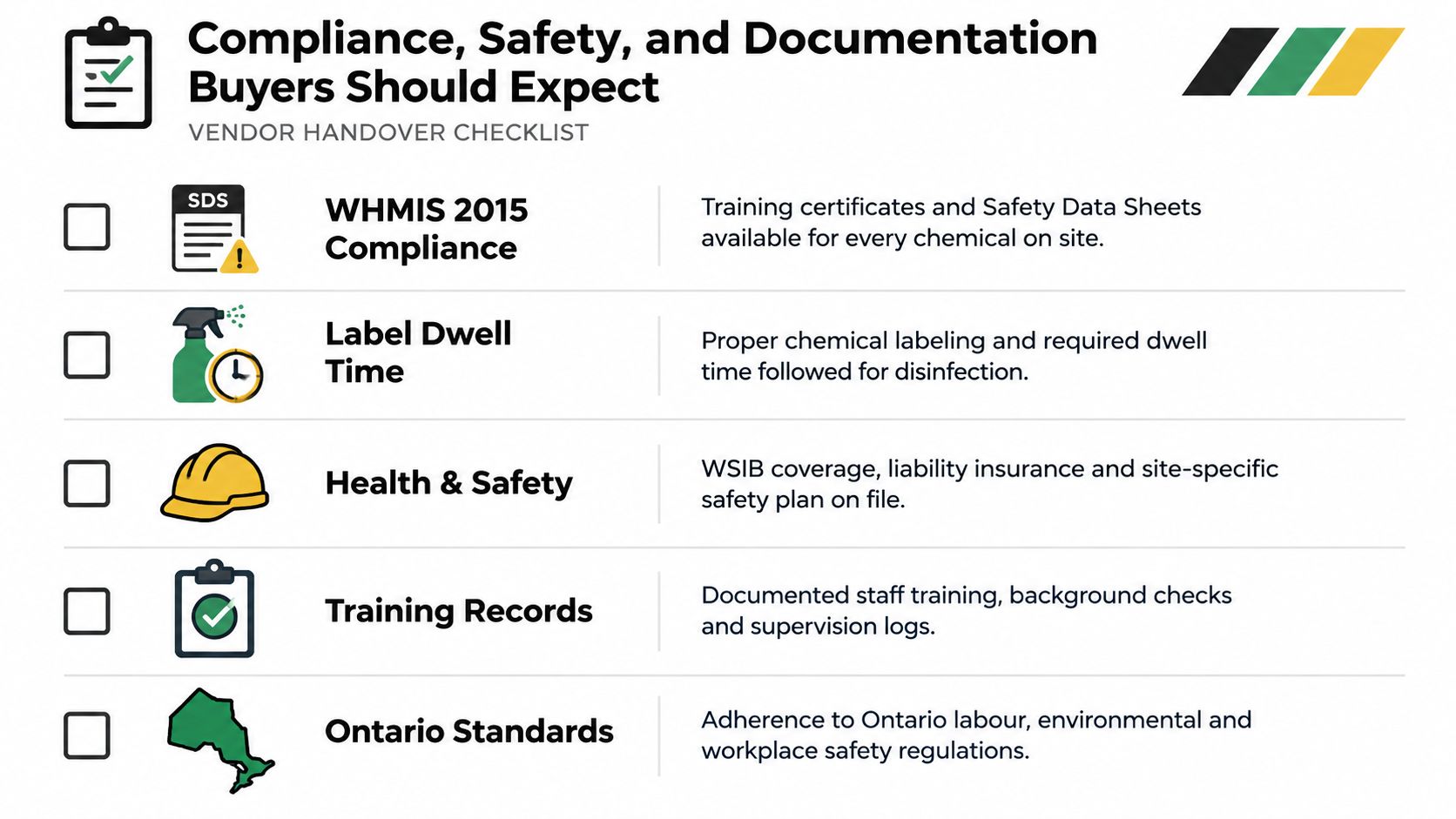
Below is some documentation that is critical in the janitorial services segment.
WHMIS records
Confirmation that workers handling hazardous products received training.
SDS access
Current Safety Data Sheets for every chemical used or stored onsite.
Insurance evidence
Liability coverage and WSIB clearance documentation.
Site risk documents
A health and safety policy, hazard assessment, and emergency procedures.
Service records
Cleaning, restocking, inspection, complaint, and corrective-action logs.
Incident process
Instructions for reporting injuries, spills, chemical exposure, property damage, and security concerns.
Ontario public procurement examples also call for recognized green-building certification or an equivalent, onsite SDS availability, and WHMIS-related training for customer personnel. Requirements depend on the facility and contract. The practical test is simple: documentation should show what happened, when it happened, and who responded.
Ontario’s 2025-2026 washroom compliance rules make this distinction more important. A washroom may appear clean, yet the buyer still needs records showing that required checks, supplies, corrective actions, and responsibilities were handled. Appearance is the result. Documentation is the procurement evidence.
The commercial disinfection and sanitizing service information shows how disinfection can be specified as a defined service. A clean-looking floor does not prove that the correct product, dilution, contact time, or inspection process was used.
How to Choose
A Vendor Evaluation Checklist and Questions to Ask
Successful customers choose a janitorial provider through a documented evaluation, not a race to the lowest price.
Two companies may promise the same nightly tasks yet differ in supervision, backup staffing, training, response time, and contract flexibility. Here are some questions to ask from the vendors who made it to the shortlist:
Ten questions for the shortlist
1 How long has the business operated, and which facility types does it serve?
2 What liability insurance limits apply to the proposed work?
3 Can the provider supply current WSIB clearance documentation?
4 Who supervises the site, and how often are inspections completed?
5 What happens when an assigned cleaner is absent?
6 Does the provider use subcontractors, and how are they screened and trained?
7 Which supplies are included, and which remain the customer's responsibility?
8 How are complaints recorded, assigned, and closed?
9 Can the provider show relevant references for a similar facility?
10 What are the notice, cancellation, extra-work, and service-recovery terms?
Ask Arelli and our team members for the answers to the questions once you’ve received your quote.
Some Red Flags to avoid
Vague scope: “Complete cleaning” without rooms, tasks, frequencies, or exclusions.
Unsupported staffing: A schedule that appears impossible for the stated crew time.
Missing safety files: No SDS library, WHMIS records, or hazard assessment.
Unclear recovery: No named contact or deadline for correcting deficiencies.
Opaque extras: Periodic work, supplies, travel, or emergency visits omitted from the quote.
| Attribute | Typical Provider | Arelli |
|---|---|---|
| Support | Business-hours or defined emergency contact | 24/7 live support |
| Quality assurance | Scheduled inspections, depending on contract | App-driven reporting and corrective-action workflow |
| Pricing approach | Quote based on site scope | Price-match guarantee stated by the provider |
| Onboarding | Site assessment and crew assignment | Intake interview, assigned crews, and close review of early cleans |
| Service flexibility | Contract-specific | No-term and stop-and-go options stated by the provider |
Why
Ontario Businesses Choose Arelli Cleaning
Arelli Cleaning is not a franchise. Every client relationship is owned directly by us — no middlemen, no contract trading, no surprises. Recognized by the Consumer Choice Award (four consecutive years), Three Best Rated, Top Choice Award, and The Best Toronto.
Price Match Guarantee. No obligation quote. Free 45-minute sample clean. Three reasons to let us bid — zero risk to you.
Ontario clients
%
Retention rate
Years in business
Local crews
Service Areas
Janitorial Services Across Ontario
Frequently Asked Questions
FAQs and Further Reading on Janitorial Services
What do janitorial services include?
How often do janitorial services run?
What do Janitorial services cost per square foot?
Who provides the chemicals and tools for cleaning services?
Who provides Garbage Bags, Soap, Paper Towels, Toilet Paper and other Washroom Supplies?
How does contract cancellation usually work?
Further reading
- Arelli Cleaning locations, service-area information for Ontario facilities.
- Commercial cleaning services, office cleaning scope information.
- Ontario labour-market job profile ↗, occupation and employment context.
- Public Health Ontario environmental cleaning resource ↗, contact time and cleaning practice.
- CCOHS cleaning staff guidance ↗, chemical safety and hard-surface disinfection.
- Ontario washroom compliance overview ↗, inspection and cleaning records.
Janitorial Services Resources for Ontario Businesses

Why Every Toronto Office Needs a Reliable Janitorial Company
A reliable janitorial company can give a Toronto office more consistent hygiene, documented safety...
Janitors will Rule. Why Office Cleaning would always need the human touch?
The strongest automation pitch in office cleaning is simple. Robots don't call in sick,...
A Facility Manager’s Guide to Commercial Cleaning, Office Cleaning, and Janitorial Services in 2026
Choosing the right cleaning service can transform a workplace from a simple building into an...
A Guide to Choosing Janitorial Services in Woodbridge
For businesses in Woodbridge, Ontario, maintaining a clean, healthy, and professional environment...
A Complete Guide to Janitor Service for Your Business
A professional janitor service is defined by the regular, scheduled cleaning tasks that maintain a...
The Modern Janitor: Understanding 10 Essential Roles in Commercial Cleaning
The term "janitor" often brings a single image to mind, but the reality of modern...